Tough luck
When life is being super unfair, just do what we all do: suffer the consequences.
I wake up and the first thing I do is check my phone. A convenient euphemism for using Facebook’s machine learning techniques to discover which 300 entries are statistically most likely to stand out from the tens of thousands of “brain dumps” my friendsUsing Facebook in this era was a surreal experience, as new generations of Internet users were coming “online” for the first time. and family have produced over the last 48 hours. I’m impressed by what Facebook provides, and I think “this can’t end well” for the thousandth morning in a row. Whether this sentiment concerns losing myself in a trance of scrolling and tapping, or the long-term civic implications of the algorithm itself is somewhat unclear. I watch a 15-second video about the #StandingRock encampment. Then, an ad for Soylent’s meal replacement coffee. I’ve been awake for maybe half an hour tops, and I’m already weighing the pros and cons of surveillance and demographic profiling.

“… according to the National Retail Federation, Americans will spend $8.4 billion on Halloween this year…” The podcast that I was listening to the night before resumes mid-sentence. By the time I’m in the shower, I’ve learned that candidates’ Halloween mask sales have predicted every presidential election since Carter. Donald Trump has refused to agree to the terms of the election (“maybe it’s rigged?” he implies). I remember reading somewhere that most voting machines are more than a decade old Note to self: track this down. I think this maybe foreshadows the Crowdstrike fiasco. — found it and I can only assume that if elections haven’t been hacked already, it’s because none of the “dangerous basement nerds” have cared enough to bother. I might be called a dangerous nerd. I’m nearly 30 years old, and I’ve never voted in an election. Why would I hack one? I’m brushing my hair and looking through the steam on the bathroom mirror as the podcast ends its segment: “… and Donald Trump’s halloween mask, it should be noted, is outselling Hillary Clinton’s by a factor of ten.”
When I tell my friends I’m working on a piece about coping with rigged systems, they note their particular preference for the most egregious one: municipal bail fees; credit card applications; diversity in the tech sector; the Diagnostic and Statistical Manual of Mental Disorders; prison labor; the Flint Water Crisis; privatized retirement funds; homelessness programs; online harassment policies; the American Legislative Exchange Council; “um, gender?!”

“Are you going to talk about that new Adam Curtis thing?” another suggests. How could I not? They were referring to a new BBC series; a sprawling epic from the calmly certain voice of the cult documentary Century Of The Self. If you don’t know him, Adam Curtis uses voice over, found footage, and a signature “rhetorical clause” to produce a kind of intellectual smut for people like me. And just like his previous works, HyperNormalisation I’m impressed that (despite the numerous moments of lazy writing in this piece) I didn’t insist on the US spelling here… is a pornography of interviews, white papers, and Ivy League history lectures that have been woven into what can only be called an incredibly reasonable conspiracy theory. His central premise: the “fictions” which describe the way our society functions are the work of politicians whose only real job is to conceal both how little power they actually have and how unstable capitalism has become.
HyperNormalisation isn’t alone. This year has seen the “systemic critique” emerge as a mainstream genre unto itself. Netflix (a company that has already established a sizable “the deck is stacked” footprint with Orange is the New Black and House of Cards) released 13th, a documentary about the exact wording of the constitutional amendment, whose language banned chattel slavery but explicitly included an asterisk for slavery as “punishment for a crime”, which has underwritten the legality of prison-powered forced labor since the end of the US Civil War. Do Not Resist, a film about the militarization of American police, won the Tribeca Film Festival’s best documentary feature prize. Mr. Robot, a manic fugue about a plot to overthrow the network of technocrats who run the global economy. Oh, and Braindead,This series is actually really good, and was somehow left out of the must-watch lists of classic “television” that came out of this period, depite its clairvoyance. the primetime summer hit about an extraterrestrial brain parasite that infiltrates Washington DC.
The list of representations of riggedness goes on. The line between documentary and fiction is becoming increasingly less relevant. The theme music has become the real-time recordings of protest chants. Soundtracks to the anti-police brutality march livestream gone viral. “The Whole Damn System! Is Guilty As Hell!”
Living in this world of open and popular hostility to the social order feels normal for me. Like many of my friends, I was a young anti-authoritarian. I despised capitalism (and politics) and (though I would struggle to understand exactly why) democracy itself. At the time, these beliefs were difficult and disorienting to arrive at, but like many adolescent discomforts, one eventually grows to call them home.
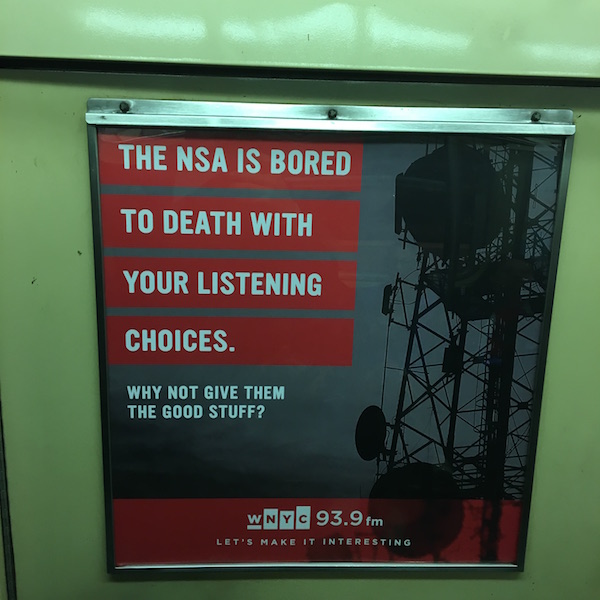
But, it’s a new game for many Americans. When Edward Snowden brought the world up to speed on the scope of state surveillance, it was an outrage. During the first months of bystander footage of weekly police killings going viral, it was paralyzing. When the Panama Papers were released last spring (documents that provide evidence that politicians, drug cartels, and the ultra wealthy were cooperating to evade tax laws and conceal fraud and corruption) Americans were barely surprised. When Bernie Sanders said “the real truth is that Wall Street regulates Congress,” it was too little too late. When emails leaked out of the DNC proved his own party systematically betrayed him: “Meh. Figures.” The public political psyche has transformed really suddenly. In the time that has passed since season three of Game of Thrones, liberal America has gone from wiping First Black President Tears to extinguishing cigarettes in their own coffee.
And like it or not, when Trump says he’s going to #DrainTheSwamp to “kill all the mosquitos” of a corrupt government at once, working class Americans on the right hear what the rest of us said goodbye to long ago: hope. Just don’t tell them the turn of phrase was popularized by Mary “Mother Jones” Harry,I might’ve made this up. Or just repeated something I saw online. I should get to the bottom of it. founding member of the Industrial Workers of the World.
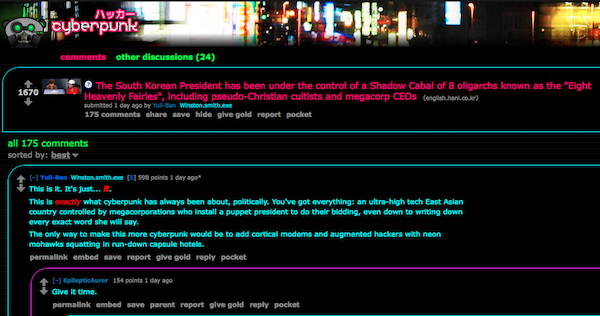
I open Reddit. Long considered the bastion of suspiciously protective “free speech” for the alt-right, it feels like an unlikely retreat. I’m generally talkative on social media. Here, I’m silent. I’m tiptoeing around, careful not to get too close to the earnest Reddit bro I could easily accidentally become.Good news: I managed to escape unscathed. I visit r/Cyberpunk, and find that the top post of the day is about Park Geun-hye, the South Korean president currently at the center of a devastating corruption scandal. In the comment thread below the post (presumably with some degree of irony) the community celebrates the breadth of the dystopia in their neon low-life affect. “The aesthetic is developing,” one user suggests, “and so is the setting.” Elsewhere in the thread, someone drops a link to an article about McGraw-Hill, one of the most powerful financial companies in the world, which also happens to publish most of the world’s K-12 textbooks. Unrelated. Dystopian. There’s nothing exceptional about this comment thread, there are billions just like it across the internet: links to conspiracy theories, Joe Schmoe’s vulgar impressions of politicians in the spotlight … arraignments of one sort or another that each go “all the way to the top”. Are our strange online cultural niches becoming sanctuaries from our own powerlessness?
Social technologies (like Reddit, Facebook, Twitter, and Snapchat, et al) are another kind of coming-to-terms with riggedness. These products are (at least upon deeper analysis) an admission that our public and private lives are subject to an invisible architecture which often functions beyond our control. Their structures imply at least some form or shape to how our realities are produced. Unlike the unwritten rules of kleptocracy, digital platforms (in theory) can be edited to produce different results. Just what exactly are we automating? All of these rigged systems? The presumption here is that once this digital transition has concluded, our political structures will be fairer, more open, more responsive to corrective actions.
But, in order to succeed as a technology company, social products need to grow quickly. Too quickly. Take Twitter: the compant has nearly the same number of users globally as the United States of America (the thirdAs of 2026, this is still true. largest country on the planet) has citizens. And despite Twitter’s indispensable place at the center of every conversation on the unprecedented leaks and scandals about political and economic corruption discussed above, it’s unclear if the platform is even valuable enough to be sold at auction.Ten year’s later, I’m laughing as I read this. Mention this dilemma on the service and you’ll hear a similar refrain from any niche that has found its place there. “Collectivize Twitter!” “Make it a public utility!” “It should be a foundation!” All surprisingly optimistic, given the conversations about the corruption of collectives, utilities, and foundations found on the average Twitter timeline.
As more about how our world is constructed and intertwined in indefensible ways becomes a matter of public conversation and consensus, technology will chart its own accelerated path to the future. Leaping over the regulating agencies that no one trusts anyway. Conducting social experiments on us without our consent (because we will get over it).This was about the Facebook negative-content engagement psychology tests. We got over it. Writing data harvesting tools for the NSA, because users assumed it was already in place and that the PR damage had been done. One by one, the responsibilities traditionally managed by the government will shift to technology companies. As users, we’re going to have to come to terms with the probability that there’s nowhere else to turn.
The corruption of the old world has rigged everything, including its replacement. We won’t like it, just like we won’t like the results of the next election, whatever they may be. But, we’ll keep on living. Making do with the injustice until the concept of justice itself is remembered as the myth it may well have been from the start. Every evening on r/Cyberpunk, someone closes their copy of Neuromancer in a world more closely resembling their fantasy. And in that future, whether we’re swiping through our timelines in the morning, letting machine learning algorithms feed us, heal us, kill us, jail us, breed us, or just make our dreams come true, we’ll remain just a little relieved that the chaos and violence isn’t worse than we privately imagine it could be.
This text was originally published in DIS Magazine on November 2nd, 2016. I revived it from the records in January 2026. When I did that, I made some light (but necessary) copy edits, and added marginal notes.